

 Español
New transitional world order
Written by Pablo González and Pedro Nonay, trying to find what we can do in our adaptation to changes in world order.
Entry 4
Shenzhen
A new Yalta, the size of a napkin.
November 24, 2026
On November 19, Trump, Xi, and Putin approved a “Declaration toward Peace” (as they called it) in Shenzhen. It consists of four points. They fit on a napkin.
Here I review the content of the declaration and compare it with what I’ve been saying in my previous entries. I’m trying to figure out where I was right, where I was wrong, and what remains open.
I’ve been saying for years that a new Yalta Conference would be needed. Something has come about, but it’s very small.
The three met in Shenzhen, taking advantage of the APEC summit (the Asia-Pacific Economic Cooperation forum). They adopted a short text, published by all three governments. All versions say the same thing, with one curious quirk: each government lists its leader first.
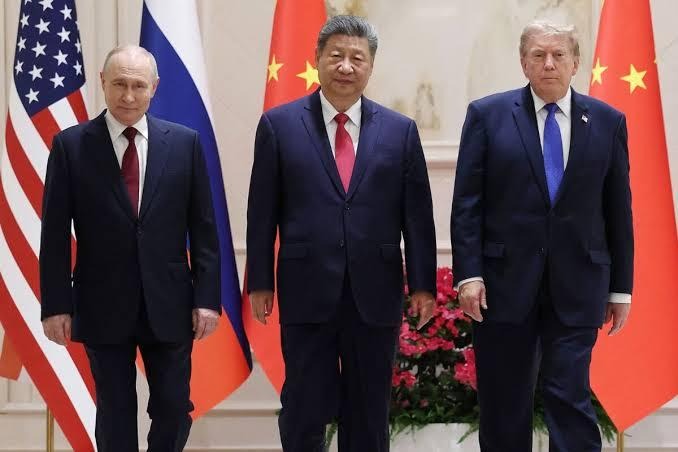
*****
Given this situation, I’ve asked the AI to find the statement published by each of the three countries, compare the versions, and compare what was agreed upon with what I’ve said in my previous entries.
For anyone interested, the english versions of what each country published can be found here, here, and here.
Afterward, I edited the AI’s response in my own way. The result is as follows.
What the statement says.
The statement is titled “Toward Peace.” In other words, peace is its primary goal (at least in theory). It is structured around the following four points.
The UN:
The three, as permanent members of the Security Council, commit to reforming it. The goal is for it to function better and return to its core mission—that is, peace and security.
In other words, they say that to promote peace, the UN must be reformed.
Energy:
They want to produce and sell more refined petroleum products, “for the benefit of all nations.” And they want energy to flow smoothly.
At first glance, this has nothing to do with peace. However, it’s clear that the war in Iran is disrupting the oil market. Therefore, what they’re saying is that this war must end (we’ll see what they come up with to achieve that).
Foreign judges:
They say that “state consent” and the immunity of high-ranking officials are fundamental.
Translation: a country—or its leader—should not be tried by a foreign court without its permission. And the International Criminal Court (the ICC, the court in The Hague that tries individuals for war crimes) and similar bodies must not abuse their jurisdiction. In Russian, the term used isn’t “jurisdiction” but “powers,” which implies much more.
At first glance, this doesn’t seem to have much to do with peace either. The fact is that neither Putin nor Netanyahu will put much effort into peace if they face prosecution.
Nuclear weapons:
They reiterate that a nuclear war cannot be won and must never be fought.
This statement is not new. Reagan and Gorbachev already said it in 1985. They add that they will discuss risk reduction and nonproliferation (ensuring no other countries acquire the bomb).
This is clearly related to peace. Furthermore, without saying so explicitly, they are implying that Iran should not possess the bomb.
An interesting detail: the phrase “toward” peace appears only in the English version. In Russian, it is “about peace.” And in Chinese, “of peace.” It seems that where we’re headed depends on the language…
*****
Based on that content, I was curious to know whether the research I’ve been doing is on the right track or not. The results are as follows:
What did I get right?
Minimum rules.
In May, I wrote: “We don’t need a new, ultra-detailed Yalta; minimal rules that allow us to manage the transition without a major war are enough” (I said this in this post).
Given the content, the agreements are much smaller than minimal, but the idea was on the right track.
The UN.
In 2023, I said that if the two powers accepted the new order, “it would be enough to begin negotiations to reform global institutions (UN, World Bank, …).” I said that here.
Well, … that is point 1 of the declaration.
Energy.
In July, I reported that the U.S. and China knew they had to reach an agreement on energy. And that neither country wants a shortage of oil to cause prices to skyrocket (I mentioned this in this article).
That is the content of point 2 of the statement.
Nuclear weapons.
In 2022, I wrote that “the risk of nuclear escalation is ruled out,” because China doesn’t want it (I mentioned this in this post).
Now all three countries state this in point 4 of the declaration.
What I didn’t get right (or isn’t clear yet)
Is the UN on its last legs?
In October, I wrote: “The UN itself is on the verge of dissolution” (I said this in this post).
Well, it seems they aren’t burying it after all. They promise to reform it. Maybe I jumped to conclusions.
A two-power world… with a third player in the picture.
I said the new order would be bipolar: the U.S. versus China (in this post). And that China wants Russia “weakened and grateful” (I said that here).
In Shenzhen, Putin is mentioned in the text on the same level as the other two. In the Kremlin’s version, he’s even listed first (each side puts itself first in its own account).
It occurs to me that Putin was invited because of his nuclear arsenal and his involvement in the war in Ukraine, in an attempt to encourage him toward peace by offering the incentive of clearing him of charges at the International Criminal Court. It’s somewhat comparable to Churchill’s presence in the Yalta photo. Of course, Great Britain was at the table, but the world was truly divided between Washington and Moscow. For London, the postwar period marked the beginning of the end of its empire, with India’s independence (1947) as a pivotal step.
AI isn’t even mentioned.
For me, AI is the fundamental tool that is changing the world (I argue this in this article).
The declaration doesn’t contain a single word about AI (or rare earth elements, which is another key issue).
Either they care less about it than I think, or they don’t see the need to reach an agreement with the other side (or don’t see the need to do so yet).
The ICC: A Standoff Between Blocs?
When the ICC was considering requesting Netanyahu’s arrest, I wrote: “It’s just another power struggle between the West and BRICS+” (I said this in this article).
Now, the leaders of the two blocs are jointly ensuring that the ICC does not overstep its authority. More than a standoff, it looks like a club looking out for itself.
The “almost-everything pact.”
In 2022, I said there were only two possible outcomes: “a ‘pact of almost everything’ (the new Yalta Conference)” or World War III (I mentioned this in this article).
This isn’t a “pact of almost everything.” It’s a “pact of almost nothing.” That said, back in May I had already scaled back my expectations to “minimum rules.” Correcting oneself in time is an elegant way to get it right.
What Remains Open.
A peace that makes no mention of wars.
The declaration is titled “Toward Peace,” but it does not name any war—not Ukraine, not Iran, not the likely conflict in Taiwan. Nor does it mention sanctions or NATO.
In 2023, I said that the U.S. and China together “can force an end to the wars in Ukraine and Israel” (I said it here). I hope this declaration is a first step toward bringing about an end to these wars soon.
Europe, left out again.
The declaration makes no mention of Europe.
After the May 14 meeting between Trump and Xi, I wrote (in this post): “I haven’t seen anything published where they said anything about Europe.” There, I said that Europe is the prize. Now it turns out that the menu… doesn’t even mention the dish. I think it might be a “surprise tasting menu.”
Talking isn’t the same as taking control.
They promise to discuss nuclear risks. But they say nothing about what to do to control those risks, nor about reducing arsenals.
In 2023, I reported that Putin was suspending Russia’s participation in the START treaty, the nuclear arms control agreement (here ). Not a single line about that.
The fine print.
It’s not even clear if it was signed: the official texts only say that it was adopted and published. Nor is it specified which language takes precedence in case of doubt, or what time the Kremlin posted it.
*****
Given what the statement says, and considering the comparison with what I’ve been saying in previous posts, I think my predictions weren’t far off the mark. I’m glad about that. Perhaps they were a bit more ambitious than what actually happened, but it’s clear that the reality of events always moves a little slower than logic would suggest. That’s just the nature of inertia.
*****
That’s all for today. I’ll continue in future posts, or so I think.
I’m very grateful to my readers for their attention and for the many ideas you’ve shared with me.
As always, I welcome comments via email: pgr@pablogonzalez.org