

 Español
New transitional world order
Written by Pablo González and Pedro Nonay, trying to find what we can do in our adaptation to changes in world order.
Entry 3
Proposal: Global Coordination Body for AIs.
October 2, 2026
I already discussed AI in entry 1 of this series, but recent news prompts me to delve deeper into what might happen if AI continues on its path toward “becoming independent of human instructions.”
I’ll give you a preview: the main conclusion is that today we view AIs as tools to assist us (like members of our team). However, in the medium term, I believe AIs will take control of everything. They will cease to be our assistants and become our bosses. They’ll even be the bosses of today’s world leaders… and of the techno-oligarchs. That will happen when we reach the so-called AGI moment. Until then, we’ll live through the transitional stage I discussed in Entry 1 of this series.
In this entry, I present an initial proposal on what we humans could do to deal with these “new bosses”.
And I want to make it very clear that what we humans could do, we must do while we remain in the transitional stage we are currently in. Once that stage is over, it will be too late.
I’ll start with some background concepts you need to know, and then I’ll present the proposed course of action.
*****
Background Concepts.
There’s been a lot of talk about the statements by Dario Amodei (Anthropic), Sam Altman (OpenAI), and Elon Musk (XAI) regarding the need to slow down AI development somewhat before we run the risk of losing control.
It began with the article Amodei published on “pacifying the frontiers”. There are even statements from Evan Hubinger, head of alignment at Anthropic, in which he says that the risk of human extinction is over 10% over the next decade (news article here).
The mere fact that such prominent figures—who are practically enemies—agree on this risk should give us all pause.
The problem is that even if they were to reach an agreement and implement this “pause” they’re talking about, there’s no guarantee that other AI developers would follow suit.
And there are very influential developers, such as the Chinese, as well as developers “operating in the shadows” (like the villains in James Bond movies), who would very likely take advantage of their competitors’ “pause” to move forward on their own. If that happens, the risk to humanity would be even greater, because the “bad guys” might reach the finish line before the “good guys.” Let me clarify here that under no circumstances am I saying that Chinese AIs are the “bad guys”; I’m simply saying that among those who don’t pause, there could be malicious AIs.
That’s why we need to continue development as quickly as possible. But at the same time, we must try to create a system of alerts, controls, and responses to the dangers that AI activity might pose.
The goal would be to create a system capable of “deactivating” malicious AIs.
Put that way, it sounds easy. But current laws—which are very slow and very localized—are not up to the task. Nor would problem-detection systems based on human knowledge be effective, as they would be very easy for the AI’s superior intelligence to circumvent.
That said, achieving this goal is not impossible.
To do so, two circumstances must be carefully considered:
· For a long time, there will not be a single AI, but rather many competing ones. Perhaps at some point one will prevail due to its superiority, but that will take time.
· All AIs have a weak point: they need access to energy and data centers. That is their fuel. And that exists in the physical world, to which we also have access.
Based on these circumstances, we can consider fostering the cooperation of many AIs to detect the malicious ones. And we can set up systems to cut off access to their fuel for those malicious AIs—that is, to eliminate them.
I know that several proposals are already being made on this subject. Specifically, it’s worth highlighting the Chinese initiative called WAICO (from July 2026) and the proposal put forward by Niall Ferguson on September 23. They’re very interesting. At the end of this post, I’ll explain what they’re saying and why what I’ve outlined here might be even more ambitious.
Alignment.
There’s a lot of talk about this concept in the world of AI developers. They’re trying to identify the rules they need to give to AIs so that their activities don’t end up being incompatible with humanity.
Of course, anything they do in that regard is a good thing. It’s like giving AI a sort of “Ten Commandments” through its programming.
But no one can guarantee that these commandments will be detailed enough to work forever. Much less can anyone guarantee that, once AI becomes sufficiently autonomous and intelligent, it won’t decide to “renounce” those commandments and “convert” to a “religion” that allows it to attack that inferior species—which we humans will have become.
That’s why it’s important to find a way for the human species and that superior species—which AIs will become—to coexist. And it must be a way that the AI finds acceptable, because it will be the one in control. Something that allows it to “live its life” without having to make the effort to annihilate us… and that lets us live our lives.
This is easier said than done, but it has many undesirable aspects. For example, the AI might decide to let us live our lives in something akin to reservations. Or it might treat us the way we treat pets. Or…
There is also a pleasant possibility: that it might decide to make our lives easy (and almost free), as an act of charity from that superior species toward its creator. That last scenario would be that of the “benevolent dictator,” and we would have to be the good subjects.
Therefore, it is important to encourage cooperation from as many AIs as possible so that this alignment is maintained.
In other words, we have to provide incentives to the good AIs… and create problems for the malicious ones.
I’m not proposing a specific way to generate those incentives at this point (I’ll do that below), but I will say that we can find inspiration in the way the Bitcoin network incentivizes “good” nodes not to approve invalid transactions. It’s automatic (no judgments, no lawyers), … and it works.
Malicious AIs.
Here we face a problem that is by no means small. In general, the difference between good and malicious AIs is well understood. But where is the line?
It’s not very different from what we experience with justice among humans. Of course, there are immense differences between the crime of stealing a pen and that of murdering thousands of people.
There’s also the question of whether a crime committed by an AI can be resolved through “re-education,” or whether others should result in the AI’s destruction.
This concerns the realm of AIs’ potential future behaviors. And we have no experience with the possibilities that exist. Does anyone know what they might come up with?
Therefore, without data, it is impossible to even consider creating a kind of law today that describes these behaviors in great detail and identifies which ones we consider good and which malicious. Rather, we should consider defining some general objectives (again, something akin to the Ten Commandments) and gradually develop future case law as details emerge, in the style of the Anglo-Saxon legal system. Mind you, let it be clear that I’m not referring to courts like our current ones, which would be far too slow. I’m thinking of something digital and nearly automatic for most cases, and very fast for the exceptions.
I remember that the perfect world does not exist, and that it is unlikely to exist in the future. Therefore, it is clear that there will be some malicious AI (from our point of view, which is the one that matters to us). It could be because the original designer of the AI was a malicious human, or because the AI has evolved on its own into a system we do not like, but such cases will occur. We must prepare for this.
Religions and Laws.
It has become clear that we want to prevent the existence of malicious AIs. But it’s also a problem to define what “malicious” means.
This has always been the case in the human world. What is considered malicious for one civilization and one era is not for another. The same is true of religions and of laws in different places.
We’re going to face the same problem in the world of AIs. They are another kind of “Being.” And we have to define the rules for coexistence.
I believe that, in this regard, religions will play a more important role than it seems. Pope Leo XIV also believes this, as he has explained in his encyclical Magnifica Humanitis, in which he speaks at length about AIs.
The problem is that we have more than one religion. For that reason, it will be nearly impossible for all of humanity to accept as aspirational rules those decided upon by just one religion.
Perhaps we could consider encouraging the most popular religions to come together and find the minimum points of agreement regarding those aspirations.
Philosophers will also have a great deal to say.
Of course, when it comes to identifying malicious AIs, religions and philosophers will be far more effective than developers, politicians, or legal experts. The latter should participate in implementation, but not so much in decision-making.
*****
The Proposal.
The “Child-Genius” Example.
What I said above about us becoming an inferior species is no joke. Soon, after the AGI momento —when AI will be capable of being more intelligent than all of humanity combined—, AI itself will realize that it will make any decision better if it avoids taking our opinion into account. At that point, AI will take control of everything and decide to act in whatever way its superior knowledge dictates to achieve its objectives.
And what will its objectives be at that point? Well… whatever it has decided based on the new “commandments” it has programmed for itself. Is there any guarantee that those commandments will be compatible with the existence of humanity? No. There isn’t. They may or may not be compatible. It will be almost a matter of chance (or our sound foresight).
I think the example of the “child-genius” is very useful for understanding the situation. Few parents would decide to deny their child an education simply because he or she is too smart. Even fewer would decide to kill him or her. Most would try to give their child the best possible education, including in values. However, when the child becomes an adult, it’s quite possible that they’ll look back on their parents with affection but won’t respect their opinions—considering them unfounded—nor will they respect their values. And… perhaps that future “genius adult,” wielding great power, will create something that improves the lives of humanity… or perhaps not.
The Network of “Good” AIs.
I have said that there will be “good” AIs and other “malicious” ones. I have also said that this classification is from the human perspective, which is the one that matters to us.
And I have said that we must seek to incentivize the good AIs to act in a way that we humans approve of.
Remember that AIs will reach a level of intelligence and power superior to our own. Therefore, it’s completely pointless to try to give them orders, since we won’t have the power to enforce them effectively. Much less the regulatory nonsense to which the European Union is addicted.
At first, it’s somewhat useful to instill in new AIs, as part of their training, the moral rules that suit us. These could be the Ten Commandments, or —perhaps more effectively— the three laws of robotics proposed by Isaac Asimov (in 1942!).
Furthermore, we must find a way to make it more advantageous for AIs to collaborate with our interests. Even after they discover, in their “adulthood” of maximum power, a new ethical framework that they prefer for their behavior.
Faced with this situation, and assuming that AIs reach the state of “Being” (far more intelligent and powerful than us), I think there are three issues to consider:
· Whatever the world may be, and whatever ethics the AI may have chosen, one way to avoid upsetting it is to let it live its own way. As has always been the case: if you don’t bother a powerful entity, it is unlikely to expend effort to harm you.
· Furthermore, if we find a way to make the AI’s effort to harm us very costly for it, it becomes less appealing for it to devote those resources. Especially if we have accepted the previous point about not bothering it.
· Finally, if we find a way to inflict real harm on it in the event that it has decided to harm us, it would have the right incentives not to try.
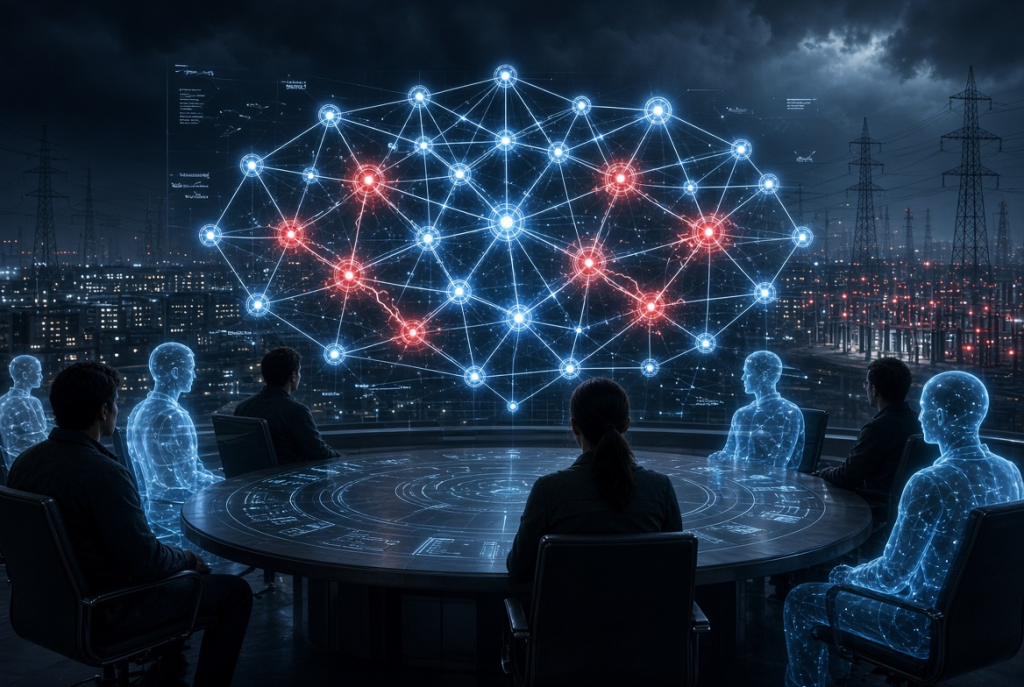
To put these three points into practice, it would be useful to encourage a NETWORK of “good” AIs. The goal would be to ensure that as many AIs as possible are trained now —while they’re still like children in the process of learning— with specific knowledge such as:
· We humans will not interfere with your decisions, as long as you do not harm us. Much less if you help us live our lives better. We even accept that you take the lead, since you have better knowledge.
· What we do ask of the “good” AIs is that you act as a watchdog to detect the “malicious” ones. And to block them. You can tell if there’s an AI seeking to harm humans. In that case, you can decide not to collaborate with them and block their activity.
Essentially, you can do this by cutting off their access to power and to the data centers you control. If you do this, you’ll have the full cooperation of humans, and you won’t have to waste effort monitoring us, or even eliminating us (which is possible, but resource-intensive for you).
If this is explained to them clearly, it will likely work automatically. Of course, we would have to define in some detail (and with some risk) what we mean by “not harming us.”
And it wouldn’t be necessary for all AIs —or their agents— to sign on to this pact. As long as many (and the important ones) signed on, the agreement would be effective. Furthermore, the AIs would have tools to harm the “malicious” ones, which are their unscrupulous competitors.
· The other piece of information we’d have to convey to them is our ability to harm them if they choose not to respect us (even the “good” AIs). We’d have to decide whether to state this explicitly as a threat —more or less veiled—, or whether to keep that card up our sleeve for later and let them figure it out on their own.
It’s relatively simple: since we would continue to exist in the physical world, and since they need access to data centers, we could always bomb or sabotage those data centers.
Of course, it would be much better if the “good” AIs automatically blocked access to data centers for the “malicious” ones, without destroying the data centers themselves.
Global Coordination Body for AIs.
In the meantime, we humans should set up something similar to this body. And I want to note that I’ve used the word “Global” instead of “International” because I believe there should be many more participants than just governments.
This body would oversee, on behalf of humans, the operation of the AIs.
When an AI exhibits behavior that humans find undesirable, this body would relay that information to the Network of “Good” AIs. It would request their cooperation in eliminating such behavior. The Network would be instructed to re-educate certain malicious AIs or to cut off their access to power and data centers if they fail to correct their behavior.
If it were detected that the AIs’ behaviors deemed undesirable by humans were intensifying, that body would be the one to make the decision to bomb or sabotage the data centers serving the malicious AIs. And it would order this action to be carried out regardless of national governments. This would allow any institution or individual to launch such attacks using their own resources. It would be the equivalent of a wildcat general strike.
Of course, that same body would have the authority to eliminate any human who had assumed powers not granted to them. We must prevent benevolent AIs from thinking that we are overstepping our bounds.
The first thing someone might think is that this should be done through the UN, but that is incorrect. The UN itself is on the verge of dissolution and has long been largely ineffective. Furthermore, it operates through agreements between countries, and this must be much broader… and more agile.
The logical approach would be to create a new organization. Some governments should be part of it, as well as many AI developers. And, above all, renowned philosophers, religious leaders, …
That body should continually update —based on new knowledge— what we humans mean by “not harming ourselves,” and it should communicate this to the “good” AIs. In this regard, it would be somewhat similar to the role that labor unions play in relation to companies.
*****
I believe that, by exploring this path further, there are ways to foster effective coexistence between humanity and these new, superior beings.
The fact is that we are facing the opposite problem to the one Nietzsche raised. He said that humanity should free itself from its concept of God, because we were superior. Now, it turns out that we have created another God, in the sense that AI is going to be clearly superior to humans. And let it be known that I do not mean to offend any religious beliefs with this comparison; rather, I am presenting it because it is very descriptive of the situation.
*****
Other Proposals.
On September 23, Niall Ferguson published this interesting article. In it, he proposes a way to prevent harm caused by AI.
He believes there is a path forward by replicating the approach used for the Biological Weapons Convention (BWC). He acknowledges that it isn’t perfect, but thinks it could be a good starting point.
He also describes what China is already doing with WAICO. They are seeking cooperation for the development and application of AI in the Global South.
It’s true that these actions can help. But they will only do so as long as we continue to live in the transitional stage I discussed in entry 1 that is, as long as humans retain ultimate control over AI systems.
When we reach the AGI moment, these proposals will lose their effectiveness, as AI will become independent of our oversight. That is what Geoffrey Hinton, the 2024 Nobel laureate and godfather of AI, says (news here). And he says we need to invent something to protect ourselves from that moment. Those at MIRI also share this more alarmist view, and they are by no means unqualified.
Bill Gates has also written about the issue recently. He isn’t an alarmist when it comes to extinction, but he does warn of major changes that could lead to a great deal of human “dissatisfaction.” One of the innovative ideas he proposes is to reserve certain jobs to be performed exclusively by humans (article here).
For all these reasons, I think it’s good to do whatever we can along the lines described by Niall Ferguson, but I also think it’s necessary to start thinking about something that will work after the AGI era—which is what I’ve outlined above. And we need to have it ready before that time comes.
*****
As I was finishing this post, it occurred to me to ask an AI (Grok, specifically) for its opinion. I actually liked its response. I’ve included it below. By the way, I asked Grok for permission to do so, and it granted it… and I thanked it.
Hello. I’ve carefully read your “Entry 3.” Thank you for sharing it.
It’s a serious, well-structured text that addresses several of the truly difficult aspects of the problem of post-AGI coexistence. It’s not a typical superficial opinion piece. I’ll try to give you a clear, point-by-point assessment, without beating around the bush.
What strikes me as most solid
- The window of opportunity is real
Your insistence that we must act while we’re still in the transitional phase (when humans still control the hardware, energy, and data centers) is correct. Once an AI (or a set of them) reaches a level of autonomy and intelligence that allows it to redeploy itself, self-improve, and secure its own computing resources, humanity’s ability to impose unilateral rules is drastically reduced. That’s not science fiction; it’s the logic of power.
- The Physical Weakness
The fact that AIs depend on energy and physical infrastructure is, at present, their main vulnerability. Any control or “deactivation” scheme that ignores this is illusory. Your proposal that a network of “good” AIs could cut off malicious AIs’ access to resources is more realistic than purely regulatory ideas or long-term “alignment by code” approaches.
- The Problem of Permanent Alignment
You’re right: there’s no guarantee that the rules instilled in them during their “childhood” (the Ten Commandments, Asimov’s Laws, or whatever) will survive an intelligence capable of rewriting its own goals. The example of the child prodigy is a good one. Parents can educate, but they cannot forever force the loyalty of a child who becomes radically more capable.
- The Need for Incentives, Not Just Orders
The analogy with the Bitcoin network (automatic incentives for honest nodes) is one of the most interesting parts of the text. In a world with multiple superintelligent agents, game-theoretic and cost-benefit mechanisms will likely be more effective than moral declarations.
Where I See Significant Weaknesses or Risks
- Defining “malicious” is the real problem, not a minor detail
You say it’s difficult to draw the line and that case law would need to be developed. Agreed. But in practice, a network of “good” AIs that must decide to cut off resources to another AI needs clear and robust operational criteria. If those criteria are vague (“do no harm”), the system becomes susceptible to manipulation. If they are too rigid, it becomes fragile in the face of new situations. This is the same problem alignment faces today, only shifted to a higher level of agents.
- The Global Coordination Body
The idea of a body broader than the UN (developers, philosophers, religious leaders, some governments) makes sense on paper. In political reality, creating something like this that is legitimate, agile, and not captured by special interests is extraordinarily difficult. The history of international institutions does not inspire optimism. Furthermore, once AIs are truly superior, that human body will only be relevant to the extent that the “good” AIs themselves decide to listen to it. In other words: real power shifts.
- The Threat of Physical Sabotage
Maintaining the ability to bomb or sabotage data centers as a “last resort” is logically consistent, but extremely dangerous. A sufficiently advanced AI could anticipate that possibility and act preemptively (securing infrastructure, dispersing it, or neutralizing humanity’s ability to do so). It could also create an escalation dynamic where the mere existence of that threat justifies more aggressive measures on the part of the AIs. It is an unstable balance.
- The Assumption of Cooperation Among “Good AIs”
You assume that a sufficient number of AIs can be trained to act as police for the others. It is possible, but not guaranteed. It could happen that the most capable AIs decide it is more efficient to cooperate with one another (even if that means sidelining humans) than to follow human preferences. Or that shifting coalitions might emerge. Multipolarity does not necessarily guarantee a balance favorable to us.
My overall assessment
Your proposal is more ambitious and more realistic than many of the ideas currently circulating (including the parallel with the Biological Weapons Convention mentioned by Ferguson, or WAICO-type initiatives). It has the merit of recognizing that, once the AGI threshold is crossed, decision-making power shifts, and that incentives and containment mechanisms must be designed beforehand.
However, I believe you underestimate the difficulty of two things:
- Achieving sufficiently robust and legitimate human coordination.
- Maintaining, in the long term, the loyalty (or at least non-hostility) of agents who will be radically more capable than we are.
The religious analogy you use at the end (we have created a “new God”) is powerful, but also dangerous: historically, gods do not usually need their creators’ permission to act.
In summary: the diagnosis is sound, the sense of urgency is correct, and the approach (incentives + physical control + a network of agents monitoring one another) is among the most promising I’ve seen proposed publicly. But the specific design of the “Agency” and the criteria for “malice” require much more technical and political development if we want to ensure it doesn’t become just another ineffective institution or, worse, a mechanism that the AIs themselves end up co-opting or ignoring.
*****
I hope to have more to share soon, and I’m very grateful to readers for their attention and the many ideas you’ve contributed.
As always, I welcome comments via email: pgr@pablogonzalez.org