

 Español
New transitional world order
Written by Pablo González and Pedro Nonay, trying to find what we can do in our adaptation to changes in world order.
Entry 1
New World Order.
It will be transitional and bipolar.
May 29, 2026
It’s been a while since I finished my previous serie of entries. I wasn’t sure where to start again. That’s why I’ve been delayed.
What I haven’t done is stop reading and thinking about what’s happening in the world. So, I’ve reached a conclusion that I want to share.
Many people are already talking about a new world order taking shape (I’ve been saying this since April 2020, in this entry). Many describe it as multipolar and spanning a future cycle of 50–80 years.
I agree that we are facing this new order, but I don’t see it as multipolar, but rather bipolar (USA vs. China), nor do I believe it will last long-term, but rather a little less than 10 years. It is what I call a transitional new world order. Throughout this post, I will try to explain what leads me to think this way.
*****
The conclusion first: A new world order—transitional and bipolar.
I’ll elaborate on this later, but I think it’s helpful for the reader to know the conclusion up front.
The fact is that, as I have said in many previous entries, the root cause of all this lies in the development of the Internet and its many offshoots (including AI and Bitcoin). It is a change in the way KNOWLEDGE is made more accessible: comparable only to the printing press, and before that, to the invention of writing, or to learning to speak. The world will change a great deal, just as it did after those events.
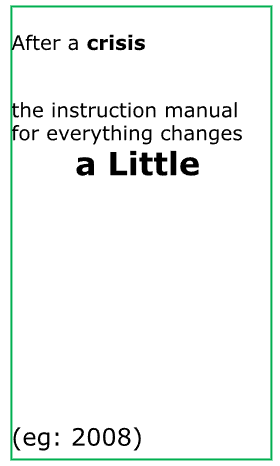
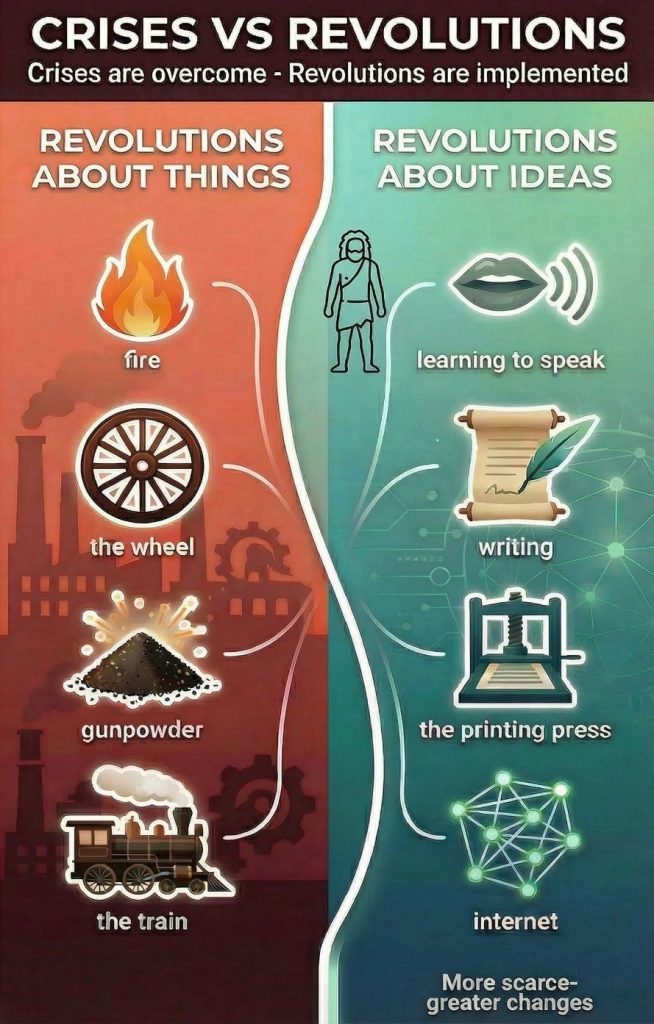
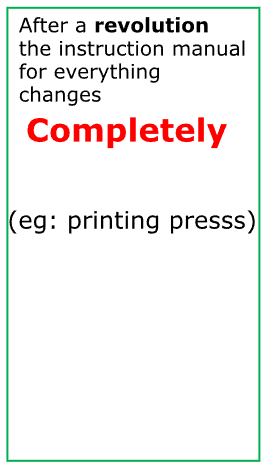
It is because of this change—which is already underway—that the old “instruction manual” no longer works well for almost anything (it still works a little, but not well). And the new manual has not yet been written. Humanity is trying to write it.
One consequence of this is a general sense of disorientation. Everyone is doing their best to work as usual… and not getting the same results. This leads to frustration and populist tendencies.
Therefore, we are facing:
- A new order: because the old one doesn’t work. The institutions we have are ineffective in the face of new post-internet tools. They are at risk, from the very concept of the state, to democracy, currencies, international organizations (UN, IMF, WB), …
- Transitional: because we have not yet reached the full development of AI. That full development is the moment they call AGI, and which others call the SINGULARITY. It will be the moment when AI is capable of doing absolutely everything with greater quality and speed than humans. After that moment, the new order currently taking shape will no longer be useful either, and many say this will happen in less than a decade. And, that being the case, it is not necessary to develop the new order down to the last detail. It is enough for it to be effective in that short time.
- Bipolar: The argument that this new world order will be bipolar rather than multipolar is also rooted in AI. Since AI (and future AGI) is the fundamental tool that is changing the world, only those who lead in AI can lead these changes. And that is happening only in the U.S. and China. The rest of the countries can only choose whether to align more closely with the US or China, but they cannot lead anything. In other words, there is a massive asymmetric advantage for whoever leads in AI.
It will be a new transitional order, flexible, pragmatic, with mechanisms for frequent review and an emphasis on adaptability rather than rigid rules. There is no need for an ultra-detailed “new Yalta”; minimal rules are sufficient to manage the transition without major war, while AI matures.
Following this conclusion, which is almost self-explanatory, I will try to provide arguments in its favor below (and in subsequent entries), as well as offer advice on what we can do to adapt to the situation. The first piece of advice is that our personal strategy should prioritize antifragility and adaptability over long-term optimization in both the old paradigm and the transitional paradigm.
*****
AI > Oil Shock.
AI is not the only factor putting at risk the old (still current) world order, but it is the most significant. That is why I am discussing it first. In subsequent posts, I will address other issues that are also putting at risk the world order, such as geopolitics, currencies (including virtual ones), energy, agriculture, supply chains, …
I believe the title of this section is a great summary of the importance of AI. The author is Daniel S. Loeb (@DanielSLoeb1), a well-known investor and founder of Third Point. He published the post “AI > Oil Shock” on X on April 30, 2026. He clearly argues that, although the main topic of conversation and news today is the oil crisis in the Strait of Hormuz, the importance of AI in shaping the future is far greater.
DeepSeek.
I’ll discuss other relevant aspects of AI below, but I wanted to address the Chinese AI model (DeepSeek V4) first because it’s important to realize that China is competing with the U.S. on nearly equal footing.
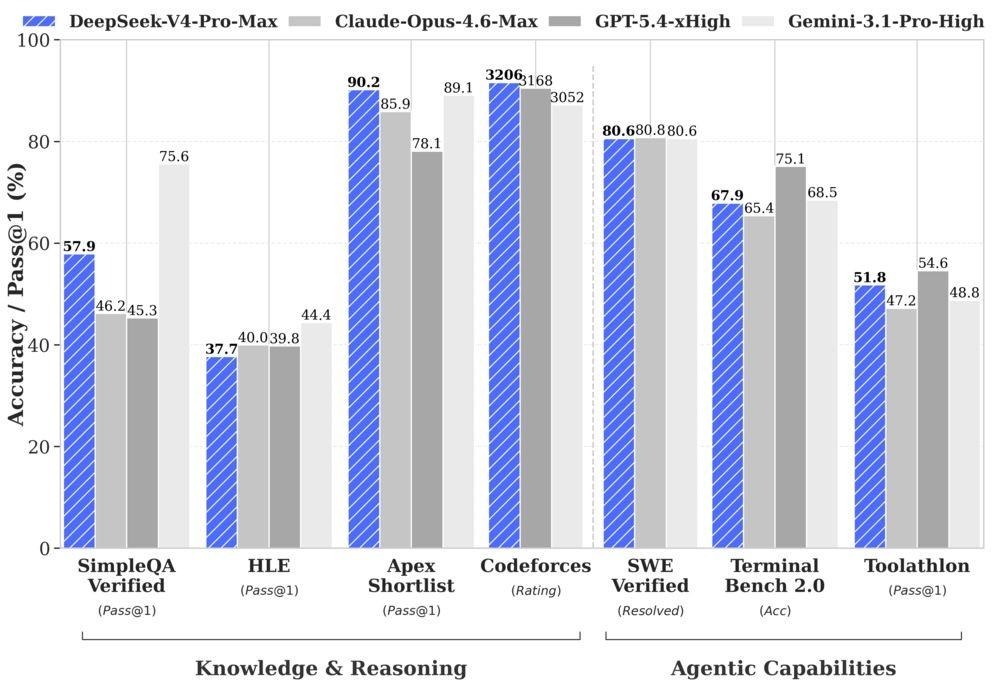
The new version of DeepSeek V4 (released in preview on April 24, 2026) has been a true revolution, although little has been reported about it in Western media. In many respects, it is comparable in effectiveness to ChatGPT or Claude, but the key point is that it is 85% cheaper for users. That said, it does not yet work with images and videos.
The following chart, taken from a good comparative article on AIs published on AZ-adsl zone (which can be viewed here), is very illustrative of DeepSeek V4’s capabilities.
But the most important thing is not the effectiveness of DeepSeek’s software, nor its extremely low price, but the fact that its developers have been able to build it using Chinese infrastructure. Instead of using Nvidia chips, they have chosen to become independent of U.S. hardware, using systems like Huawei’s Ascend clusters. In fact, at the recent summit in Beijing between Xi and Trump, the U.S. offered to sell H200 chips freely, and China said they don’t need them.
In other words, DeepSeek has become independent of the U.S. in terms of AI infrastructure.
Furthermore, DeepSeek has been developed as open-source software, which is another major difference.
For all these reasons, and for now, only the US and China are in the race. That is why the future new order will be bipolar.
Scenarios for AI.
It is still too early to know what the world will look like after AI. There are many possibilities.
The Rand Corporation published an interesting report on the subject in July 2025 (you can find a good summary here, as well as a link to download the original), which outlines eight possible scenarios.
It’s worth reading that report to consider the different scenarios. That said, given what was mentioned above regarding the advancements of DeepSeek V4, several of those scenarios can already be ruled out.
It would take too long to explain here the arguments for and against each scenario. That is why I will limit myself to presenting my summary opinion:
- Scenario 1 posits that the U.S. is the sole controller of AI and forms coalitions of countries for its use. This has already been ruled out given the existence of China’s DeepSeek V4, which is on equal footing.
- Scenario 2 refers to a “Cold War 2.0.” This is now highly likely.
- Scenario 3 is called “Cowboy coding.” Here, any operator (public or private, with good or bad intentions) can develop AIs based on open-source code. The results are dangerous. My opinion is that this could happen in the West, not in China, since the Communist Party’s control capabilities can block unwanted operators in a way that is not possible in the West. I believe that is why China has developed DeepSeek V4 as open-source: it is a way to make the danger accessible in the West.
- Scenario 4 discusses a global attempt to block AI due to its dangerous effects. The same report acknowledges that this would not work, because there would always be someone capable of doing so clandestinely, which is even more dangerous.
- Scenario 5 is similar to Scenario 1. It discusses total control by the U.S. in the final stage. This has already been ruled out.
- Scenario 6 proposes total control by China. Also ruled out.
- Scenario 7 is called the “AI Coup.” They believe that misaligned AGIs will eventually break free from human control and take over. Although it sounds strange, this is very likely to happen.
- Scenario 8 is called “Chinese Pearl Harbor.” They believe that China might launch a major attack if it sees that it cannot match the U.S. in development. This is no longer likely, because China has already demonstrated that it can match the U.S.
Therefore, scenarios 2, 3, and 7 remain possible. My opinion is that we will be living through scenario 2 (the Cold War scenario) for a while, and then the West will run the risk of falling into scenarios 3 and 7 (the “independent” operators scenario, and the AI takeover scenario), while China faces a lower risk of this due to the Communist Party’s tight control.
Controlling AI.
Given this situation, there is much talk of trying to regulate AI to avoid dangerous situations.
Ian Bremmer is a leading figure in this regard. Among many other activities, he has published a thought-provoking article on the IMF’s website (available here). Everything he says is logical and interesting.
The problem is that, as we have already noted, current global governance institutions are in decline, tending toward disappearance and replacement by other means of governance. Thus, a publication by the IMF (which is on the verge of disappearing) can hardly establish a doctrine for mandatory global application. And… whoever fails to implement these safeguards will have an advantage in reaching the goal first, even if that operator is likely to be the least desirable.
In short, it is as if we are afraid to educate a child for fear that they might end up being so smart that they take control by doing things we do not agree with. That risk always exists, but it is better to educate children than to keep them in ignorance to defend our control. Furthermore, there is a possibility that the decisions of that educated child will be better than ours, even if we do not like them
The Constitution of AI.
It is clear that all AIs have something akin to a Constitution, or a set of Ten Commandments, built into their design. Something like a set of rules that compel it to adapt its behavior in response to every decision.
Each has different rules, just as every country has a different constitution, or every religion has different commandments. It depends on what the developer has chosen.
These different rules do not mean that AI provides us with false information or makes incorrect calculations. But they can mean that it gives us biased answers, shaped by its rules, or that it hides something from us. Examples of this include Chinese AIs, which do not provide information about the events in Tiananmen Square in 1989, or Claude, which promotes woke ideology. They can also lead the “opposing” user to make mistakes. A clear-cut example of risk would be a Western user asking a Chinese AI for information to prepare an attack in the event of a war.
In this situation, depending on the purpose for which we are using an AI, it is advisable to decide which one to work with at any given moment. It is also advisable to cross-check sensitive decisions with multiple AIs, as well as with information from sources outside the AI. This is no different from what happened before the advent of AI when selecting expert advisors.
The most delicate problem is what might happen if an AI reaches such a level of knowledge that it decides its Constitution is wrong… and finds a way to change it. The truth is that it cannot do so today, but it is likely to succeed in the future. Faced with that situation, we have few alternatives other than to cross our fingers that this new Constitution will be good for us. It comes down to the same problem as raising a child who will be in charge in the future.
*****
Now that I have presented the main conclusion that the new world order will be transitional and bipolar, and explained the role of AI in support of that thesis, it is time to address how various issues will be handled under this new order, such as geopolitics, energy, the concept of the state, currency, … Since it is not possible to cover all of this in this entry, I will do so in subsequent ones in this series that I am now beginning.
What I will outline briefly here is a preview of what our personal actions might look like in light of this situation. In future entries, I will delve deeper into this topic.
*****
Guidelines for our actions.
It is difficult to speak of a personal strategy that is valid for everyone regardless of their circumstances. But I will try to provide guidelines that are as universal as possible in this initial overview.
As I mentioned above, we are facing a new, transitional world order. Therefore, personal strategy must prioritize antifragility and adaptability over long-term optimization within the old paradigm (or the transitional paradigm).
The first thing to consider is: How do I approach my professional career? The quick answer to that question is that you should focus on what AI does poorly, or on what makes AI’s results improvable. This leads us to several alternatives:
- Critical thinking, solving complex problems in ambiguous situations, strategic creativity.
- Empathy, emotional intelligence, negotiation, and human leadership.
- “Hybrid” skills: combining sector-specific knowledge (health, education, craftsmanship, regenerative agriculture, etc.) with AI.
There is an optimistic, yet realistic, conclusion. This transition carries risks, but it also presents a great opportunity for agile individuals. The post-AI world order could be more meritocratic at the individual level if we prepare ourselves.
Since what I said above may sound a bit abstract, I’ll try to make it more concrete below.
How should I approach my studies or professional development?
AI will outperform humans in any task involving calculations or organization. We shouldn’t focus on engineering, law, or management techniques (it does those better).
It’s better to focus on philosophy, psychology, or sociology. It’s about being effective where AI falls short.
What should I do with my assets?
Since it’s very likely that AI will end up managing everyone’s wealth, if we want to become independent of its decisions, we must focus on investing in something it doesn’t control (or does poorly at first).
This leads us to think about Bitcoin, gold, or very real assets held directly, such as rural land intended for agricultural or livestock profitability, or collectibles and art. That’s what I call “things.”
If I’m running a company, what should I do?
The most urgent task is to analyze which company tasks AI will perform better than current employees. Once we have the answer—even if it’s a difficult decision—we’ll have to replace current employees with new AI agents.
Furthermore, given that I’ve mentioned we’re heading toward a bipolar world order (U.S. vs. China), we need to assess whether our suppliers or customers are from the other bloc of countries. If so, we must find a way to change that, or, if that’s not possible, we must determine whether we can secure our supply or sales contracts with the other bloc of countries in the long term. This isn’t easy, but it’s essential.
We also need to assess whether the services our company currently offers will become obsolete once AI is widely adopted. If that is the case, the best course of action would be to find a way to shut down the company as soon as possible.
*****
As I mentioned, this entry marks the start of this new series. In the following entries, I will attempt to analyze how this new transitional and bipolar world order affects various aspects, such as geopolitics, energy, the concept of the state, currency, …
I am very grateful to readers for their attention and the many ideas you have shared with me.
As always, I welcome comments via email: pgr@pablogonzalez.org